It’s awesome that people are increasingly planting native plants in their gardens.
They can certainly offer beautiful and unique flowers. One small shrub with quite humble flowers is quietly becoming popular.
The midgen berry, particularly the attractive Austromyrtus ‘Copper Tops’ variety, combines ornamental appeal with edible fruit, hardiness and wonderful wildlife value.
These features really make this shrub a great choice for our South Burnett gardens.
Native to coastal regions of eastern Australia from northern New South Wales through to southern Queensland, the midgen berry is well adapted to local conditions.
It grows naturally in sandy soils like ours and also in open woodland. This helps to explain its ability to thrive in both coastal, suburban and rural settings.
Here at Ramesa Nursery we have a couple of midgen berry shrubs currently bearing fruit near the entrance to the nursery and also have a few down in ‘The Shrubbery’.
‘Copper Tops’ is a compact, evergreen shrub available in tube stock; when fully grown it reaches one metre in height. Its tidy form makes it ideal for borders, low hedging, rockeries and pots.
I quite like its soft leaves as well as its fresh copper-toned new growth.
This new growth gradually deepens to a glossy green, providing year-round interest while mixing wonderfully with other plants.
In spring and early summer, the shrub produces masses of small, star-shaped white flowers.
These are highly attractive to bees, butterflies and other pollinators, adding movement and life to our gardens.
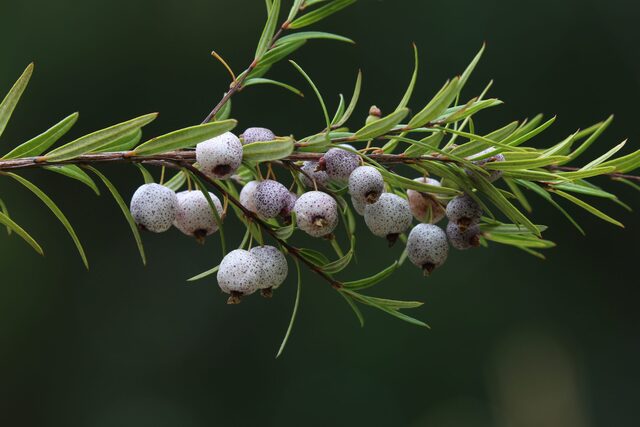
As the season progresses, the flowers develop into small, pale berries lightly speckled with purple. They remind me of tiny speckled eggs and are quite beautiful.
Although small, the midgen berry fruit delivers a surprisingly complex flavour which is often described as a blend of blueberry, ginger and spice. Another person has mentioned that it tastes a little bit like passionfruit. Perhaps try some yourself and let me know what you think.
Not only is midgen berry valued for its toughness due to being tolerant of dry weather, it also requires very little maintenance.
The plant is easily grown in full sun and also grows well in part shade areas, as we have done here at Ramesa.
I find that the plants really offer flexibility for a range of garden designs. In fact, some will be planted around our ‘Butterfly Walk’ sign soon for everyone to enjoy.
Establishing a midgen berry plant is easy, with slightly acidic conditions being ideal. By adding organic matter such as compost, pine bark/needles or tea, we can improve growth and cropping, particularly in alkaline soils.
Water regularly for the first few months to establish the plant, then it will be happy and become relatively drought-tolerant.
A light prune after fruiting helps maintain a neat shape and encourages bushier growth.
I recall intending to do this to a few pots of midgen berry plants. After being late in getting around to it, I noticed they became quite leggy – so trimming is definitely recommended.
Also, an annual application of a low-phosphorus native fertiliser in early spring will support healthy foliage and consistent fruiting.
The berries are best harvested when fully ripe, at which point they feel slightly soft and are easily picked by hand. Eat them fresh, add them to desserts, bake them into muffins or make them into jams and sauces.
My favourite use for the berries is to pop a few into a brown paper bag and freeze them, making little icicles.
I hope you enjoy this small, attractive, wildlife-friendly and wonderfully productive plant.
Happy gardening!