WARNING: This story concerns matters of child abuse and features the names of people who have died. Reader discretion is advised.
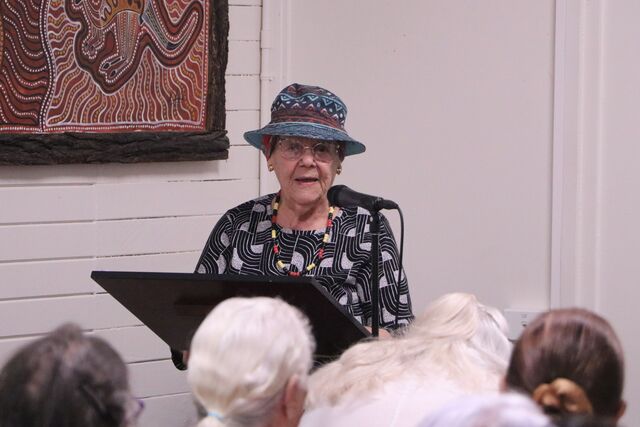
Celebrated author Dr Ruth Hegarty, 96, spoke about her experiences in the Cherbourg Girls’ Dormitory during the launch of a new exhibition at the Ration Shed Museum on 2 October.
The Dormitory, we know it very well.
We know it because we lived it. We lived it for most of our lives.
Even at my age of 96, we can talk about the things that we did as children.
It’s amazing that Dormitory people can love each other and talk to each other about those times even to this day and age. I’m happy that we’re doing something here to recognise that we are ‘Domo people’.
[Cherbourg] was known first as Barambah Mission and was built by the [Queensland] government to house Aboriginal girls under the so-called Aboriginal Protection Act of 1865.
Behind its two-storey [facade] it was a place of strict control, surveillance and forced separation from family.
That’s the thing that hurts most of all: separation – not only from tribes, but those of us who lived in the Dormitory were separated from our families.
I entered with my mother as a baby in 1930, and [was] placed in the little girls’ ward.
If you lived in the Dormitory you know there was a little girls’ ward and a big girls’ ward. There’s a separation of the latticework that we weren’t allowed to go into.
Our mothers, our aunties, our grandmothers that were taken were living on the other side, and we weren’t allowed near them.
The girls of the Dormitory were trained for one purpose, and we all know what that purpose was: to work as cheap labour.
At 14 we were sent to cattle stations. Our wages were stolen by the government in the name of ‘care and protection’.
For more than a century, Aboriginal lives and labour were exploited to help build this nation. They took everything of ours to build this nation.
This exhibition holds deep significance for the many hundreds of girls and women who spent their lives in the house.
Apart from a small plaque placed in the yard where the original building once stood, long destroyed, there has been little recognition of what this place truly was. It was two-storey, it looked good from the outside – but from the inside, it was terrible.
The outside was built up with high fences, barbed wire and roses that grew over the wire, so we were never able to get out of the place.
Without exhibitions such as this, our history and our stories risk being erased, leaving governments free to silence the truth of our past.
They would love us to go. They would love us to say nothing.
But we will not go away, because we have generations that are coming behind us. Generations whom we have taught about what life was like.
We hope and pray that these generations will continue the fight.
It’s a truth that we are fighting for now. It’s a truth that we want everyone to know about: the truth of what life was like not only in Cherbourg but up north.
It was all over the place – they wanted to frighten us, they wanted people to know that we were telling lies.
My own life in the Dormitory and my memories I kept in my book ‘Is That You, Ruthie?’. I have promised the girls I grew up with that, one day, I would write a book.
We were only kids aged 14, ready to go to work – not educated in anything, just taught how to be clean, how to be disciplined.
Unfortunately, the government had another rule: that, as soon as you turned 14, you left. I was at school when I was collected.
My uncle Eric came down – he was a policeman at the time.
We all knew in my class of 23 girls that, one day, a policeman would come down on your birthday and take you down to the office – or to the matron, who would give you a permit to go over to the office – and when you went there, they would give you an order for the store.
The things you bought in the store were things that were bought with our monies, our stolen wages. We were buying back our own things, spending money on things that should have been given to us for free.
We were never people to have toothpaste or toothbrushes. No one had scented soaps – we only had carbolic soaps.
We had one towel between 15 girls. By the time the bath was finished they’d be wringing out that towel so that the other girls can have it also.
I do a lot of research, and I read about what the government says about what they had given to us.
Pattycakes? Honestly, it just about makes you sick. That’s a lie! We weren’t looked after like that, at all.
Without mothers and families this was a frightening and lonely time for many of us.
Frightening because you had no one to hug you at night. Frightening because you had no one to take you to the toilet.
We had a drum there, and we knew that we could only go number one in that box. If you wanted to do a number two, god bless you. You couldn’t even get anyone to take you to the toilets which were a long way out.
You would say ‘where is my mama?’ She could have been on the other side of that lattice door, but she also wasn’t allowed to contact us.
I remembered as I wrote my book that she sat in that big dining room. We were on one side and our mothers were on the other.
I said to her ‘didn’t you know that every time I dropped a spoon on the floor that it meant I was wanting you to turn around?’ She said ‘and if I turned around, Ruthie, I’d get in trouble.’
I would be made to stand in the middle of the dining room until everyone had finished eating. My dear friend Marcia would save me a little piece of damper, and the bell would ring for school.
I speak for the little girls, because the night that my mother and I separated I went into the little girls’ ward, into a small bed.
Those little girls are mothers now, grandmothers. Most of them have died.
I must say here that I am the only one left of my group. At 96 they are all gone.
We loved each other – they became our family. We are family to each one of us, and we’d do anything for each other.
We were sent to work on cattle stations for little pay.
The people paid me five shillings a week; the government took half of that. I was only paid two and sixpence.
Can you imagine, Cherbourg people, Aboriginal people, how much money the government collected from all of us, all of Queensland, all of the missions, that went to work?
Someone in the office told me ‘you’re going to have a bank account’. That pleased me very much!
But we were told after doing some research that all of the money was put into one big heap. No one had a bank account!
And that money built hospitals, main roads, loans – but nothing came back to us. It was nothing worse than abuse and exploitation of Aboriginal labour.
My daughter and I wrote a letter when the new [Queensland] premier [David Crisafulli] came in.
I wanted him to know that a lot of our menfolk worked as cane cutters [as his grandfather did] and they didn’t get paid full wages. But he didn’t answer my letter. One day I’ll meet up with him.
For more than a century governments profited from the stolen earnings of our people. They want to forget us. We are the forgotten people.
They profited, very much so, and stolen lives of Aboriginal people helped to build the nation that we know now.
Yes, this is the nation called ‘Australia’. I tell people I’m Gunggari. We all have a nation that we belong to. Australia, take care of yourselves.
Reconciliation is not about money. It’s about truth.
We must let people know the truth, and I am not frightened of telling anybody.
It is about embracing the other half of our history – the part that had been, for too long, silenced. They’d like us to be silenced.
As I look around this room I see the families here – most are descendents of the Dormitory girls.
Over the years, many have come to me and asked questions. I would like to say to them that I have been at nearly every funeral of these girls. I made it my business.
When we all get to heaven, what a day of rejoicing that will be!
I see a lot of my friends here, and in those faces I see the tears of the little girls who once longed to ask ‘mama, where are you? Are you there, mama?’ A lot of them never knew their mums.
There is a huge debt owed by government.
We have been short-changed, for more than a century, under the so-called system of ‘care and protection’. What a laugh!
We need our education. We will grow – yes, we will grow!
Because you young people now, you have the responsibility of carrying this lot further afield.
Do some research, do DNA, find our who your parents are.
We must all do that. We will live comfortably together.
READ MORE: