WARNING: This story concerns matters of child abuse and features the names of people who have died. Reader discretion is advised.
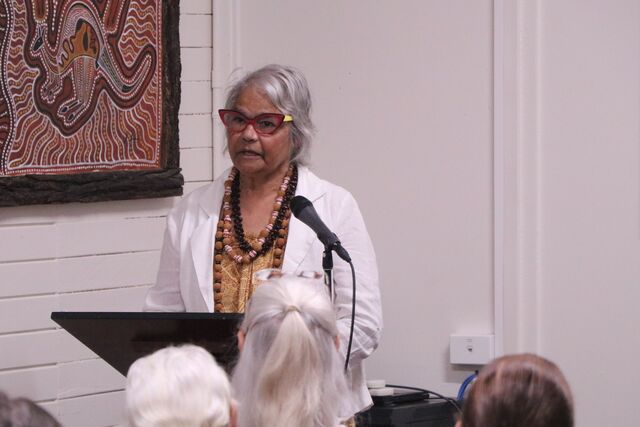
Joanne Willmot shared stories of her life as a ‘Domo girl’ at the Cherbourg Ration Shed Museum on 2 October.
I was a Cherbourg Dormitory child.
I actually was taken from my mother in the early [19]50’s, when I was born, and placed in the babies’ quarters here at the Dormitory.
Not many people were placed in the babies’ quarters. Can you imagine being born and not being attached or connected to anyone?
The person I saw as my mum was Aunty Eva Collins, who passed away a few weeks ago, and her daughter, Andrea.
The Dormitory was a complex place for all of us. Not all Dormitory girls can articulate what happened to them: the pain, the trauma, the agony, the distress, the dehumanising.
The attitude that we were merely just useful to scrub the floors, polish the floors, wash the floors.
It didn’t matter what age we were – you got up at five o’clock in the morning, and you did all your work before you went to school.
When we were punished for arguing and fighting as kids, we were made to stand on one leg for two hours in the corner.
If we moved, we had to change to the other leg and we had another two hours.
If we cried or we got upset, then the switch came out.
Do you know what a switch is? All the mob from Cherbourg know.
That long piece of limb from a tree that cut really hard on the skin. We got flogged until we bled or we couldn’t move.
As children, if we were very naughty, we were locked in the women’s prison at the back of the Dormitory. There were no lights there, and we were yelled at and told we would be flogged if we kept screaming and carrying on.
We had no one to protect us. We had no idea that adults were around who actually cared for us, who even bothered to want to know what we were going through.
We had no one to talk to. We didn’t even talk to one another.
I remember when the Forde Foundation offered redress for what happened to Aboriginal people in the institutions like that missions, the reserves and the dormitories.
It was then that we all started to talk, us Dormitory girls, about what our experiences were.
We were quite shocked that the other girls actually had the same experience.
They kept us really busy. They kept us controlled. We went from one bed to another so that we didn’t get too comfortable sleeping next to another sister.
My mother was sent out to work. She had two boys, who were in the boys’ dormitory.
I had no idea, until I was nine, that I had two brothers. How do you live in a small community and not know who you are connected with, who you belong to?
That wasn’t the purpose of placing us in this institution. That was one way of absolute control: you feeling totally alone and isolated.
I remember going to bed at night and praying, asking why they say Jesus loves me and all the children of the world – and here we were being beaten and whipped and traumatised.
We weren’t being saved. I just wanted to die. Every night I’d pray ‘can’t you just come and take us? We don’t belong in this world. We keep hearing it at the church but we don’t feel it.’
What gives you that resilience and that resistance to keep on keeping on when you’ve got nothing? Where is the foundation of your identity, your dignity and your passion?
I remember we used to go and have bush food. If it was found out by the matron that we were eating bush tucker, we were forced to have castor oil.
If you got sick from the castor oil, they kept giving it to you until it stayed in your gut. Then you were flogged, and then you were made to stand in the corner.
We’d go to the hall and the doctor would come in to do all of these checks on us.
They’d give us worm medicine, munyu [lice] medicine, every other medicine you can think of, and sent us on our way. If you had munyus they shaved your head.
Most of the treatment of us as kids was very humiliating. We were called ‘inmates’ then. We weren’t even human. We were nobody.
If we all dropped dead the day after, no one would miss us – it didn’t matter. They were hoping for that, but they’d quietly say it.
The Dormitory was a place that gave us shelter from the storms outside but it didn’t prepare us for the terror, the torture and the trauma of what we had to go through inside.
None of us could talk to one another about what our experiences were for the fear that we’d be dobbed in by our sisters. They had set up a system where we all could dob in one another and we’d get extra food for our next meal.
The sad thing is, all of my sisters that I tried to bring here for this event were either unwell or had died. That’s the only original family that I had. That’s our family, and it’s all disappearing very slowly.
I’m a Wakka Wakka woman. I took my grandchildren to meet their Wakka Wakka ancestors in Biggenden and Gayndah, in the cemeteries, because I believed that I needed to continue that ongoing connection of family, spirit and culture.
I would like us to spend more time talking to one another about what Cherbourg really is. Who does it truly represent?
For us who live outside of Cherbourg, this is where we started. We still have our heart, our spirit and our soul here. We want to help continue to rebuild it.
Let’s work out how we can make it the best community it possibly can be across this whole country, so that it can be a showcase.
We’ve come from the depths of the war. We’ve come from a place where Cherbourg was a crime scene, and still is in some ways.
Only we can challenge that and make a difference.
We’re willing to do that, because we want our children to come here and be inspired, and know they carry the spirit of their elders when they walk on this country.
READ MORE: