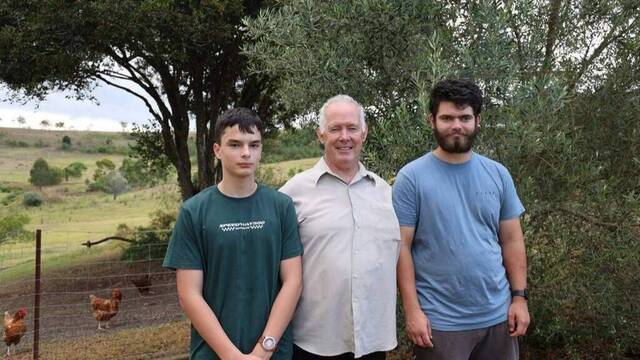
A Crows Nest boy experienced a brush with death after trying to free a flying-fox from a drawn-out demise on his family’s barbed-wire fence.
William, 14, as well as his brother Jack and father Mark received emergency vaccinations against a range of diseases after the former was scratched by a flying-fox on 10 October.
William was injured when he tried to help the bat, which could have seen him exposed to the lethal Australian bat lyssavirus – a disease with no known cure.
He and his family received five vaccinations by Darling Downs Health staff following the incident, with a physician for the organisation afterwards warning members of the public to steer clear of entangled bats for their own safety.
“While there is the temptation to help sick or injured bats or flying foxes, it is imperative that people do not touch them unless they are appropriately protected,” said DDH public health physician Dr Alan Lam.
“This protection includes vaccinations for rabies, appropriate training in bat handling and the use of personal protective equipment,” he added.
“We didn’t want the flying fox to suffer, and we still wouldn’t — but after seeing William need painful injections and a series of vaccinations for all of us, we now understand the risks and would get advice first in future,” said William’s father Mark after the family received a clean bill of health.
Australian bat lyssavirus and other diseases borne by flying-foxes such as Hendra virus are transmitted by the bats via bodily fluids like saliva. Of the four zoonotic viruses borne by bats Australian bat lyssavirus is the only one that can be transmitted to humans without an intermediate host, meaning people can be infected through direct contact with a diseased flying-fox.
When humans contract Australian bat lyssavirus, they show rabies-like symptoms like fever, convulsions and paralysis, leading to death. No human has survived the disease once symptoms have manifested.
“We urge anyone who has been scratched or bitten by a bat or flying fox to seek medical advice immediately,” DDH’s Dr Lam said.
Barbed-wire fences meanwhile continue to present a lethal hazard to animals like flying-foxes.
Flying-foxes are nocturnal; when they glide from tree to tree in dim light they are unable to see the thin wire fences until they are already on a collision course.
Once a bat hits the fence, its sharp points are likely to pierce the animal’s thin wing membranes causing it to get stuck. Entangled bats typically struggle, leading them to further ensnare themselves.
Either the injuries themselves or the resultant exposure to high temperatures, starvation and dehydration then prove lethal to the bats.
A 1999 study into the mortality of bats and gliders entangled in barbed-wire fences found standard farm fences of a metre in height were particularly dangerous to the animals. A report from the late 1990’s described 200 bats caught on the same North Queensland barbed-wire fence at once.
A 2011 report described that most rescued bats have to be euthanised due to their injuries.
Other airborne animals like gliders and birds and even larger species like wallabies, kangaroos and emus are also susceptible to entanglement in barbed-wire fences.
To report injured or sick flying-foxes or other animals, contact the RSPCA on 1300 264 625, the Queensland Department of Environment, Tourism, Science and Innovation on 1300 130 372, or local wildlife carers.