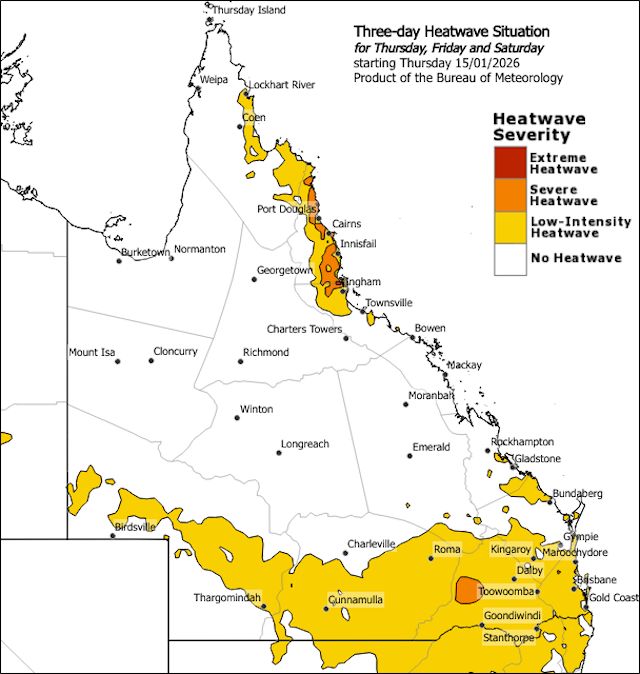
The Bureau of Meteorology has issued a low-intensity heatwave warning for parts of the North and South Burnett regions starting this weekend.
Bureau heatwave prediction systems claim that, from Saturday 17 January until at least Monday, residents of the Burnett regions should expect high day- and nighttime temperatures.
On Saturday, the predicted low-intensity heatwave will affect the South Burnett towns of Kingaroy, Murgon, Nanango, Proston and Wondai as well as Eidsvold and Mundubbera to the north, with Gayndah just on the edge of the warning area.
By Sunday, the North Burnett town of Monto will likely also be affected by the heatwave.
Come Monday, select pockets of both regions are still expected to record high temperatures, with the North Burnett more heavily affected than its southern neighbour. Eidsvold and Mundubbera will remain in the warning area according to the Bureau, while Proston will be the only South Burnett town still affected.
On Tuesday, 20 January, the Bureau of Meteorology predicts that close to the entire North and South Burnett regions will no longer suffer from the low-intensity heatwave.
The Bureau defines a heatwave as a period where an area’s maximum and minimum temperatures are “unusually hot” over a period of at least three days when compared to the average climate.
The classification also factors in nighttime temperatures, with an area’s inability to cool down after dark making it more likely to be declared as suffering from a heatwave.
When publishing its heatwave warnings the Bureau uses a three-tiered system, stating an area either suffers from low-intensity, severe or extreme heatwaves.
A low-intensity heatwave is described as being “frequent during summer” while still being manageable by the majority of locals.
Severe heatwaves meanwhile are less frequent but more challenging for “vulnerable” people including the elderly and those with medical conditions.
An extreme heatwave is a rare phenomenon and affects anyone who remains outside for a prolonged period of time, posing major heat-related health risks as well as being able to cause disruptions to the transport-, energy- and agriculture sectors.
The Bureau of Meteorology suggests people in areas covered by a heatwave warning seek cool shelters such as air-conditioned public spaces, as well as close their windows and draw their blinds at home during the daytime.
To view the Bureau’s heatwave prediction map, visit: bom.gov.au/weather-and-climate/specialised-forecasts-and-observations/heatwave